The following morning, I went outside to check the lemon tree.
There were three small green lemons on the branches.
I laughed aloud.
“Well, look at you.”
A breeze stirred the leaves.
I went inside and made coffee, then sat at the kitchen table with the window open and the sun on my hands.
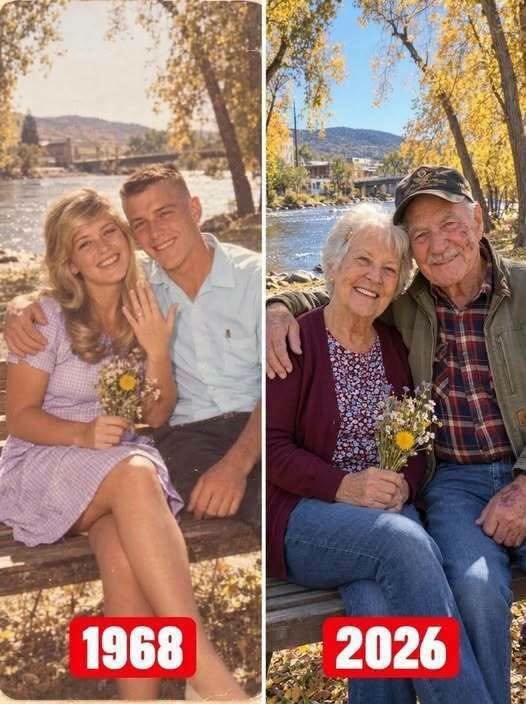
I thought of Danny at eighteen, standing beside the river in his ill-fitting jacket, asking me to dance. I thought of the ring he had bought with money he could hardly spare. I thought of the letters, the hospital, the years of silence, and the old man who had finally found the courage to send a jar of flowers to a woman he had once loved.
I thought of the young girl in the yellow dress who had believed love meant waiting forever.
She hadn’t been wrong to love him.
She had only been wrong to think that waiting was the same as living.
The phone rang.
It was Selena.
She was sorting through her father’s belongings and had found something she wanted me to have.
“I’ll bring it down next weekend,” she said. “I think you’ll like it.”
“What is it?”
“You’ll have to wait.”
I laughed.
“Your father used to say the same thing.”
“I know.”
There was a pause.
Then she said, “He was happy at the end, Susan. I want you to know that.”
I looked out at the lemon tree.
“So was I.”
After we hung up, I took a fresh sheet of paper from the drawer.
For years, I’d imagined what I might have said to Danny if he’d written to me after leaving the hospital. I’d imagined the letter I’d have sent back, the questions I’d have asked, the anger I’d have poured onto the page.
But those letters had never been written.
There was no point writing them now.
Instead, I wrote a letter to the girl I had been at eighteen.
I told her that she would lose people she loved. That some promises would be broken, and some would be kept in ways she couldn’t imagine. That she would marry a good man and raise two good children. That she would bury her husband and learn to sleep alone. That one morning, nearly sixty years after a boy in an Army uniform left her, she would open her front door and find a jar of wildflowers.
I told her not to be afraid of the life waiting for her.
I told her that happiness was not betrayal.
I told her that grief did not have to be a house she lived in forever.
And I told her that the boy who called her Dandylion would find his way back, though not in the way either of them had dreamed.
When I finished, I folded the letter and placed it in the Whitman’s box.
Then I went outside.
The afternoon sun was warm, and the three lemons hung from the tree like small green lanterns.
I stood beneath them for a long time.
I was seventy-eight years old. My knees hurt. My daughter worried too much. My grandchildren were growing up faster than I could bear to watch. My husband was gone, and my first love was gone, and the house was quieter than it used to be.
But I was here.
I had my memories, my family, my garden, and the life I’d built with the people who had stayed.
And somewhere inside that life, there was still a girl in a yellow dress, laughing at a boy who couldn’t spell her favorite flower.
I could almost hear him.
Dandylion.
I smiled.
Then I went inside, made myself a cup of tea, and sat down by the window to watch the light fade.
For the first time in a very long time, I wasn’t waiting for anyone to come home.
I had learned, at last, that some people return to us only long enough to help us lay down the things we’ve carried.
And some loves, even after a lifetime apart, find a way to bloom again.
Not as they were.
Not as we imagined.
But as something real, and tender, and finally at peace.
THE END
For Complete Cooking STEPS Please Head On Over To Next Page Or Open button (>)