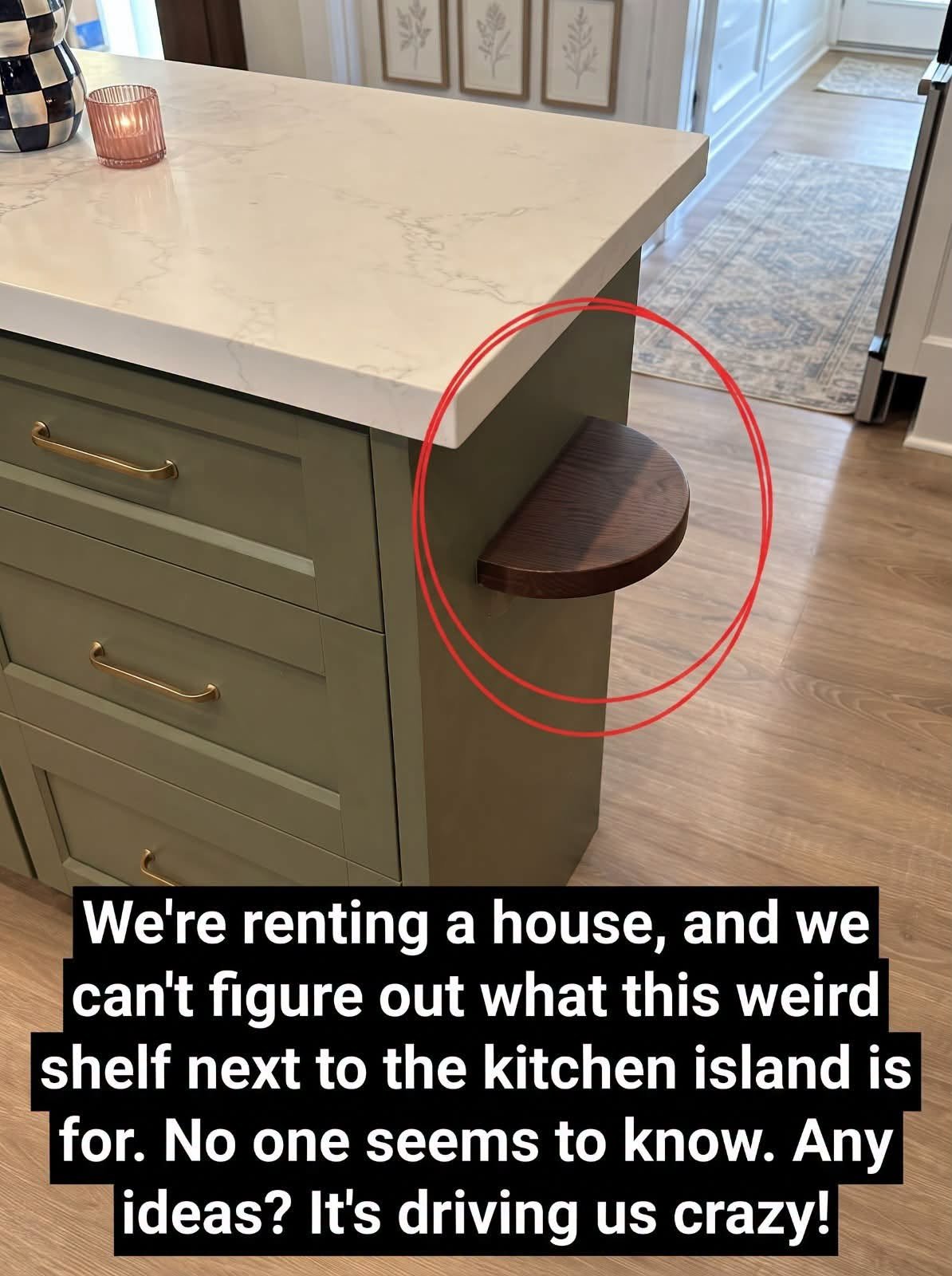
If the kitchen island is where everyone gathers in the morning, the ledge can provide a convenient place for a coffee mug.
It keeps the mug off the main preparation area without requiring another table.
Hold Your Phone
This might be one of the most useful modern purposes.
If you’re cooking from a recipe on your phone, the shelf can provide a small landing spot nearby.
It’s also handy when you’re unloading groceries and don’t want your phone sitting directly on the countertop.
Display Small Decor
A tiny shelf can be a perfect place for a small decorative piece.
Try:
- A little potted plant
- Small vase
- Decorative bowl
- Candle
- Tiny framed piece
- Seasonal decoration
Because the shelf is usually located at the end of the island, even a small object can become a visual accent.
Create a Mini Serving Station
When you’re entertaining, that little ledge can become a temporary landing place for a small plate, appetizer dish, napkin holder, or drink.
Just remember that the exact weight capacity depends on how the shelf was constructed.
Keep a Recipe Nearby
If you prefer printed recipes or recipe cards, a small ledge can give you a place to keep one close without putting it directly beside ingredients and spills.
Is It Designed for Sitting?
No—don’t assume it is.
This is one of the biggest mistakes someone could make with a small island ledge.
A kitchen island seating area is usually designed with enough depth and structural support for a person.
A narrow decorative shelf is not necessarily built that way.
Even if the ledge looks sturdy, that doesn’t mean it was designed to support someone’s weight.
So don’t use it as:
- A seat
- A step
- A ladder
- A place to stand
- A perch for children
It’s a shelf.
Treat it like one.
Why Is the Shelf Sometimes Rounded?
The rounded shape isn’t necessarily just for looks.
A rounded edge can make sense in a busy kitchen where people are constantly walking around the island.
Sharp corners can be easier to bump into, particularly in narrow kitchens or high-traffic areas.
A curved shelf can also soften the overall appearance of a large, boxy island.
Instead of ending with a hard rectangular corner, the little ledge can give the island a more finished, furniture-like appearance.
And let’s be honest—it looks cute, too.
Is It Mostly Decorative?
Sometimes, yes.
Not every kitchen feature needs to have a major practical purpose.
A shelf can be both decorative and functional.
A small ledge might have been added primarily to break up a large cabinet side or provide visual interest.
But that doesn’t mean you can’t use it.
If the shelf is sturdy and intended for light-duty use, there’s nothing wrong with turning it into a convenient place for small objects.
Kitchen Island Shelf vs. Seating Overhang
These two features can look similar at first, but they’re quite different.
| Feature | Small Island Shelf | Seating Overhang |
|---|---|---|
| Main purpose | Light-duty storage/display | Seating |
| Typical depth | Relatively shallow | Much deeper |
| Designed to support a person | No | Yes, when properly constructed |
| Good for drinks | Yes | Yes |
| Good for decorative items | Yes | Sometimes |
| Good for stools | No | Yes |
| Intended for standing | No | No |
The easiest clue is usually depth.
If there is enough room for your legs underneath and enough countertop extending outward to comfortably sit at the island, you’re probably looking at a seating area.
A narrow little ledge is a different story.
Why Put a Shelf on the End of the Island?
The end of a kitchen island can be an excellent opportunity for small-scale storage or display.
Instead of leaving the panel completely blank, a designer can add a shallow shelf.
This can:
- Break up a large cabinet surface
- Add visual interest
- Create a small display area
- Provide a convenient landing spot
- Make the island feel more like built-in furniture
- Add function without sacrificing much space
It’s a relatively small design detail that can make a kitchen feel more intentional.
What Shouldn’t You Put on It?
Because these shelves vary in construction, it’s smart to keep the load light unless you know the shelf’s rated capacity.
Avoid putting heavy objects on a narrow decorative ledge, especially if they could fall onto someone walking past.
I’d also avoid storing things that could easily create a hazard, such as:
- Heavy cookware
- Large appliances
- Tall glass bottles
- Sharp kitchen tools
- Large stacks of dishes
- Anything that could easily be knocked onto the floor
A small shelf is most useful when you don’t ask too much of it.
Can You Add One to an Existing Kitchen Island?
Potentially, yes—but this is where you need to think about construction.
A shelf isn’t simply a piece of wood attached to the side of an island.
The wall or cabinet structure behind it needs to provide appropriate support, and the shelf needs to be securely attached.
If you’re considering adding one yourself, think about:
The Island’s Construction
Is the end panel decorative, structural, or part of the cabinet assembly?
The Shelf Material
Wood, plywood, laminate, stone, and other materials all have different strength characteristics.
The Brackets or Supports
A floating-looking shelf still needs adequate support.
The Intended Load
A shelf for a small plant is very different from one intended to hold dishes.
Clearance
Make sure the shelf doesn’t create an awkward obstacle in a walkway.
For a built-in modification, a cabinetmaker or experienced carpenter can help determine the best way to attach it securely.
Small Kitchen Features Can Be Surprisingly Useful
One of my favorite things about kitchens is that the smallest details often have the most interesting stories.
A narrow pull-out cabinet has a purpose.
A toe-kick drawer has a purpose.
A little tray tucked beneath a counter can have a purpose.
And that strange little shelf on the side of the island?
It isn’t necessarily random, either.
It may be there simply because someone realized that a few inches of otherwise unused space could become useful.
Frequently Asked Questions
What is the little shelf on the side of my kitchen island called?
There isn’t one universal name. It may be described as an island end shelf, side shelf, display shelf, ledge, or kitchen island ledge.
The terminology can vary between designers and cabinet manufacturers.
Can I put a coffee cup on it?
Usually, yes, provided the shelf is intended for light-duty use and is stable. It’s a natural use for a small island ledge.
Can I sit on a kitchen island shelf?
No. Unless the feature was specifically designed and rated for seating, treat it as a shelf rather than a seat.
Can I put a microwave on it?
That’s generally not what a small decorative ledge is designed for. A microwave is heavy and requires adequate support, ventilation, and appropriate clearance.
Why is the shelf rounded?
A rounded shape can provide a softer visual transition and reduce the chance of bumping into a sharp corner in a busy kitchen.
Can I use it for plants?
Absolutely, assuming the shelf gets suitable light and can safely support the planter. A small plant can be one of the nicest ways to use the space.
Is the shelf structural?
Usually, the shelf itself is a functional accessory rather than a major structural component of the island. However, construction varies, so don’t assume its capacity without knowing how it was built.
Can I install one myself?
A simple shelf can be a manageable DIY project for an experienced homeowner, but an integrated island shelf may require careful attachment to the cabinet structure.
If you’re unsure what is behind the island’s end panel, it’s worth getting professional advice before drilling or cutting.
The Little Shelf You Probably Never Thought About
It’s funny how something can sit in your kitchen for years without you ever asking why it’s there.
That tiny rounded ledge doesn’t look important.
It doesn’t hold a whole collection of dishes.
It isn’t big enough for serious storage.
It certainly isn’t another countertop.
But that’s exactly the point.
It’s a little bit of useful space where you might not otherwise have any.
A coffee mug.
A phone.
A small plant.
A cookbook.
A serving dish when friends come over.
Nothing dramatic.
Just a convenient little landing spot built into the kitchen.
And once you understand what that shelf is for, you’ll probably start spotting them everywhere.
Final Thoughts
The next time you see a small rounded shelf attached to the side of a kitchen island, don’t wonder whether the cabinetmaker simply ran out of ideas.
It may have been intentionally designed as a light-duty shelf and display ledge.
It’s a tiny feature, but it can make a surprisingly useful difference.
And that’s what makes kitchen design so interesting.
Sometimes the best features aren’t the enormous islands, expensive countertops, or fancy appliances.
Sometimes they’re the little details you almost overlook.
Like that mysterious little shelf sitting quietly on the side of the island.
Now you know what it’s there for—and you may never look at one quite the same way again.
For Complete Cooking STEPS Please Head On Over To Next Page Or Open button (>)